
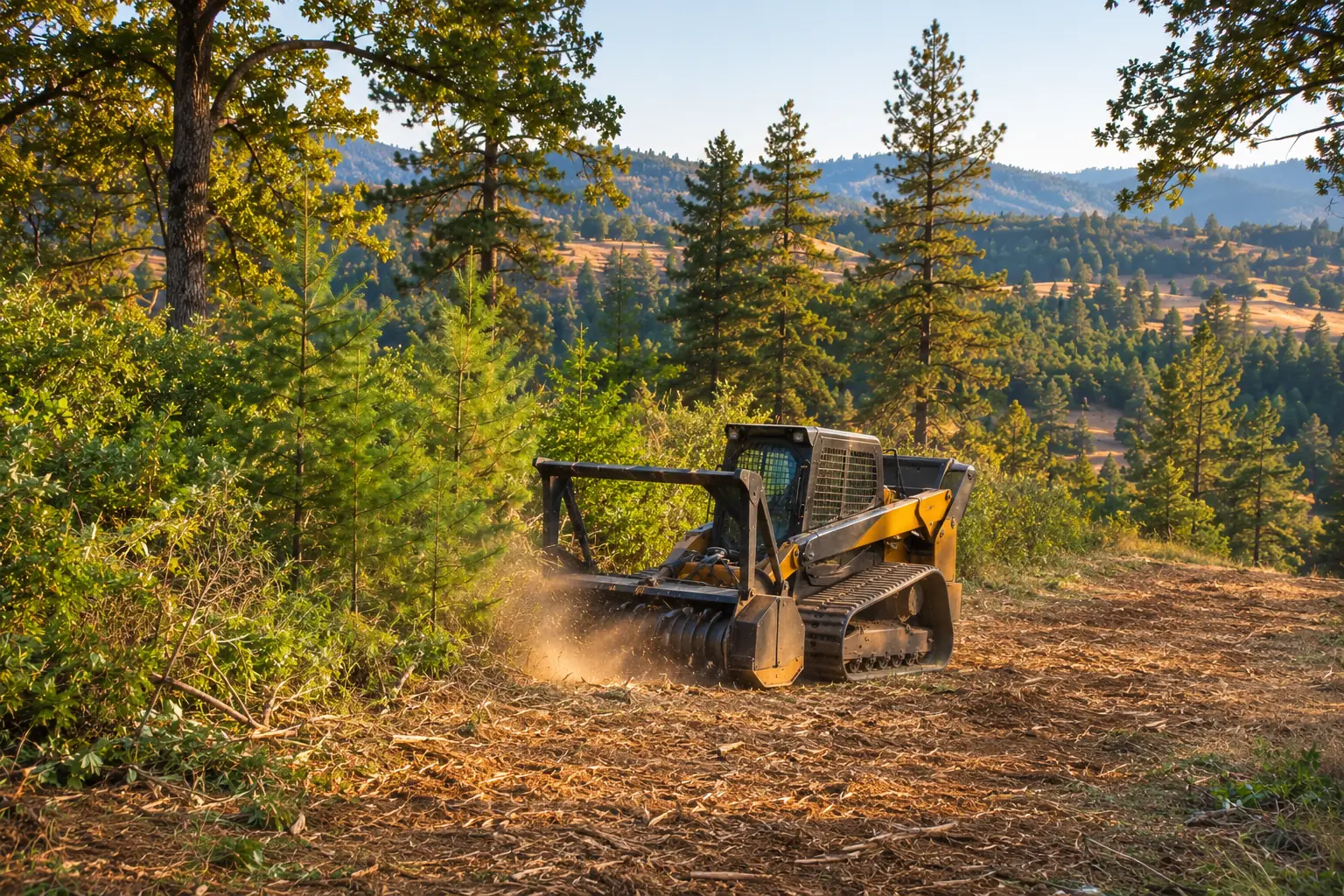
Land clearing around Rogue River takes out trees, saplings, brush and stumps across a building site, pasture or overgrown acreage, then chips, mulches or hauls what was cut. A free call to (541) 855-3193 connects you with one independent tree service with an Oregon CCB license. Ask whether it will walk the ground and price the job in writing. Estimates on everyday jobs tend to be free, but acreage takes longer to look over, so find out what the visit costs, if anything.
What a land clearing job covers
Land clearing is bigger than trimming or brush work, and the scope should be written down before anyone starts. A full job can include:
- Felling trees that stand in the way of a house site, driveway, shop or pasture.
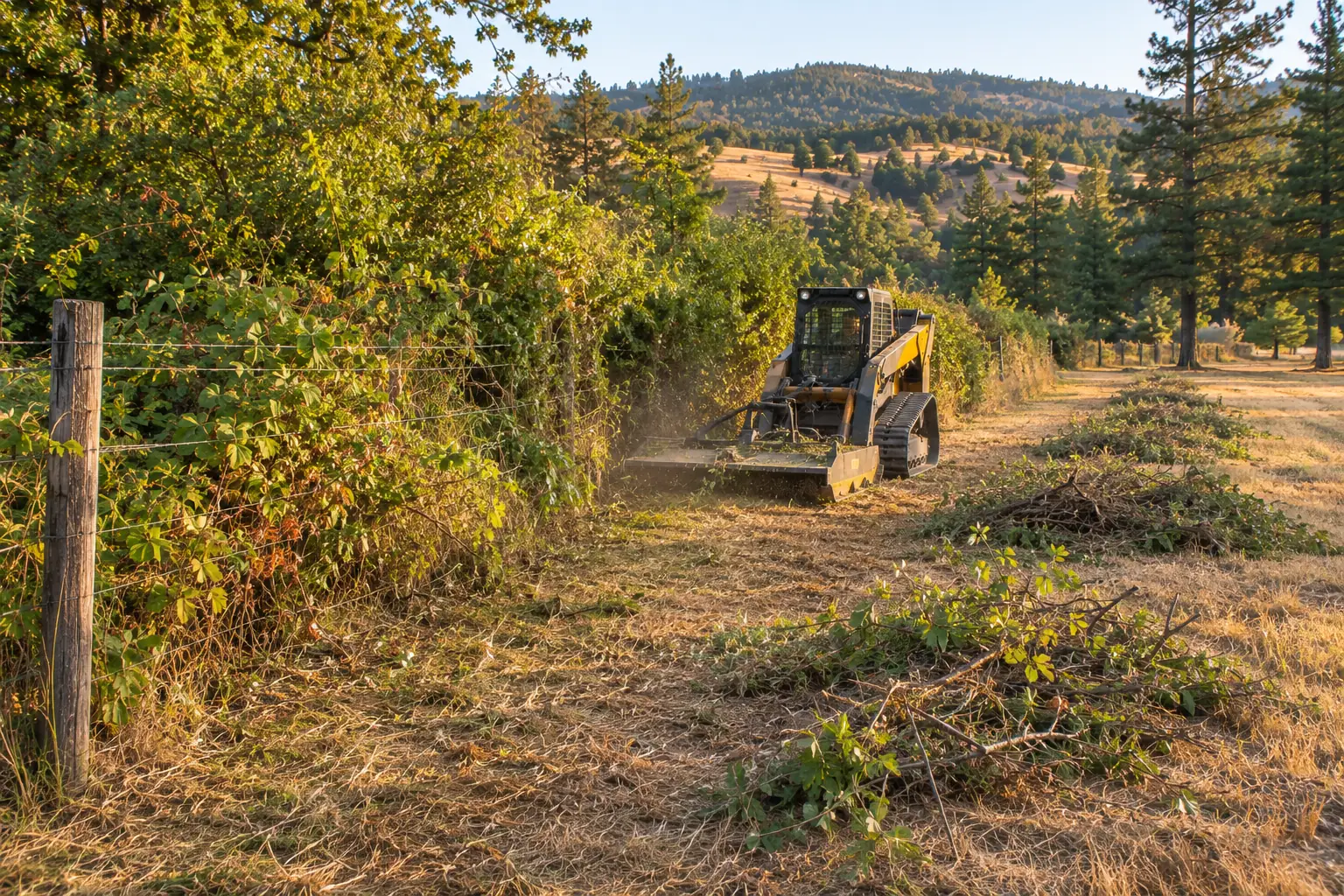
- Cutting or mulching young trees and brush across the area.
- Grinding or pulling stumps where the ground will be built on or plowed.
- Chipping, mulching or hauling the debris.
- Leaving chosen trees standing, often oaks and big pines, with their roots protected.
Many owners only want part of that list. A hillside lot thick with young trees may need selective thinning. A new home site may need full clearing on a small footprint and lighter work around it. Brush alone, along fences and driveways, is covered on the brush clearing page.
Clearing methods compared
The method shapes the price, the soil and how the land looks afterward. Ask which one the company plans to use.
| Method | How it works | Suits | Watch for |
|---|---|---|---|
| Forestry mulching | A tracked machine with a spinning drum shreds brush and saplings and leaves the shreds on the ground | Brush, saplings, fuel reduction on slopes | Leaves a mulch layer; does not take out large stumps |
| Excavator or dozer clearing | Machines push over and pile trees and pull stumps | Building pads, roads, full clearing | Heavy soil disturbance and erosion risk |
| Saw crew plus chipper | People on foot fell and limb, and the cut brush is fed through a chipper | Steep or tight ground, selective work | Slower, priced by the day |
| Selective thinning | Crews remove chosen trees and leave the rest | Woodlots, fire spacing, views | Needs clear marking of what stays |
Lawn Love's land clearing cost guide, updated December 27, 2025, notes that basic clearing may not include stump removal, so check that line in every bid.
Plan before the machines arrive
A clearing job goes better when the owner has answered a few questions in advance.
- Decide the end use. A house pad, a garden, a pasture and a fire buffer each need a different finish.
- Mark what stays. Flag trees to keep with bright tape, and mark the outer edge of their root zones so machines stay off them.
- Find the property lines. Clearing past a line onto a neighbor's land is a costly mistake. Use a survey if the corners are unclear.
- Locate buried lines. Any machine moving earth counts as excavation. The Oregon Utility Notification Center's FAQ says to call 811 no later than two full business days before the work, and notes most utilities mark only to the meter, leaving private lines to you.
- Find the water. Mark creeks, seasonal drainages, the well and the septic system.
- Think about slopes. Bare soil on a hillside can wash into a creek in the first winter rains. Ask how the company will control erosion.
Rules for clearing near Rogue River
Several agencies can have a say in a clearing job. Check with each one that applies to your land before work starts.
Creek and river setbacks
Inside city limits, the riparian chapter protects a 75 foot strip measured from the Rogue River's top of bank and a 50 foot strip along Evans Creek, Wards Creek and other fish-bearing streams. Section 17.135.040 lists all filling, grading or excavating and the expansion of lawns among the prohibited activities there, and section 17.135.050 requires a riparian development permit before development in the corridor. Outside the city, the county's soil and water conservation district publishes a riparian guide that gives the same distances and says clearing or thinning there is not allowed by default. It lists clearing riparian vegetation, removing healthy trees and placing soil, gravel or fill near streams among the things that need prior approval.
The city chapter also notes that state and federal permits can apply near water, including the Oregon Department of State Lands removal-fill permit.
County planning
Jackson County Development Services handles land use outside city limits. Its contact page lists (541) 774-6900 for the main office and (541) 774-6907 for planning information. Ask about setbacks, grading and any overlay on your parcel before clearing for a building site. Inside the city, start with the planning page or City Hall at (541) 582-4401.
ODF notification
ODF's E-Notification page says the person responsible for forestry work on non-federal land must notify ODF before it begins, and should file at least 15 days ahead. It also says filing through the online service has no fee. If the clearing involves harvesting timber, ask the company whether it will file the notice.
Fire precaution levels for bigger operations
Large clearing jobs with heavy equipment can fall under ODF's industrial fire rules during fire season. ODF's Industrial Fire Precaution Levels for land it protects west of the Cascades set four steps:
- IFPL I, Fire Season. Fire season requirements are in effect and a fire watch is required.
- IFPL II, Limited Shutdown. Power saws (except at loading sites), feller-bunchers with rotary head saws, cable yarding, blasting and metal welding, cutting or grinding may run only between 8 p.m. and 1 p.m.
- IFPL III, Restricted Shutdown. Cable yarding is prohibited with narrow exceptions, and ground-based machines and their power saws may run only between 8 p.m. and 1 p.m. where equipment able to build fire line can quickly reach a fire start.
- IFPL IV, Complete Shutdown. All operations are prohibited.
In 2026, ODF's Southwest Oregon District opened fire season on May 15 at IFPL I. The district's regulated closure rules, which limit saw and engine hours by daily fire danger, also cover the lands it protects. Ask the company which rules govern your job. Call ODF's Medford Unit at (541) 664-3328 if you are unsure. Many owners schedule clearing between fall and spring to avoid both.
Getting rid of the debris
Burning land clearing debris is tightly limited. Inside Rogue River, the city's open burning chapter bans burning land clearing waste at any time of year. DEQ's Southern Oregon outdoor burning guide says state rules also prohibit burning for land clearing, notes that violations can bring fines of up to $12,000 per day, and suggests chipping or composting on site instead.
That leaves three usual options:
- Mulch in place. A forestry mulcher leaves the material on the ground as a mat.
- Chip and spread or haul. Chips can line paths and roads or leave on a truck.
- Sell or keep the logs. Larger trunks can become firewood or saw logs. Ask the company whether they offset the price.
What land clearing costs
Land clearing is priced by the acre, the hour or the job, depending on how thick the growth is. Lawn Love's land clearing cost guide, updated December 27, 2025, gives a typical national project range of $1,565 to $4,520, an average of $2,900 and hourly rates of $120 to $265. It lists these per-acre ranges:
| Type of ground | National range per acre |
|---|---|
| Brush only | $330 to $630 |
| Lightly forested | $580 to $2,100 |
| Heavily forested | $3,300 to $5,600 |
| Forestry mulching | About $450 |
The same guide lists stump removal at $130 to $350 per stump and hauling tree and yard waste at $60 to $515. Steep hillsides, rock, long hauls from rural roads and work near creeks push prices up. Budget from the written bid, since the ranges above are national. The tree service cost guide compares clearing with other jobs.
Questions to ask before you hire
Get answers to these on paper:
- What method will you use, and what will the ground look like after?
- Are stumps included, and how deep will they be ground or how will they be pulled?
- Which trees are staying, and how will you protect their roots?
- Who files any ODF notice and places the 811 locate?
- How will you control erosion on slopes and near water?
- Which CCB license number do you work under? Confirm it is active on the Oregon CCB license search. The Oregon Landscape Contractors Board's tree work FAQ says a CCB license covers removing trees and grinding stumps.
Owners in Sams Valley, Wimer and along the river often clear in stages. For fire spacing around a home, see fire-safe limbing. The home page lists every service covered.
Frequently asked questions
Is a permit needed to clear acreage near Rogue River?
It depends on where the land is and what you clear. Creek and river setbacks need city or county approval for clearing, and building sites can need county land use review. Call the city or Jackson County Development Services before work starts.
Can I burn the brush and trees from clearing my lot?
Inside Rogue River, burning land clearing waste is banned at any time. DEQ's Southern Oregon guide says state rules also prohibit burning for land clearing. Chipping or mulching is the usual answer.
What is forestry mulching?
It is clearing done by a tracked carrier with a toothed rotor on the front, which shreds brush and young trees as it drives over them. It is quick on brush and young trees, but large stumps usually need separate work.
How many days will a clearing job take?
It depends on the growth, the slope and the method. Light brush can go quickly with a mulcher, while heavy timber with stumps takes much longer. Ask the company for a time estimate with the bid.
Should I keep any trees when clearing?
Most owners keep some, especially healthy oaks and large pines away from the house. Mark them before work starts and ask the crew to stay off their root zones.