
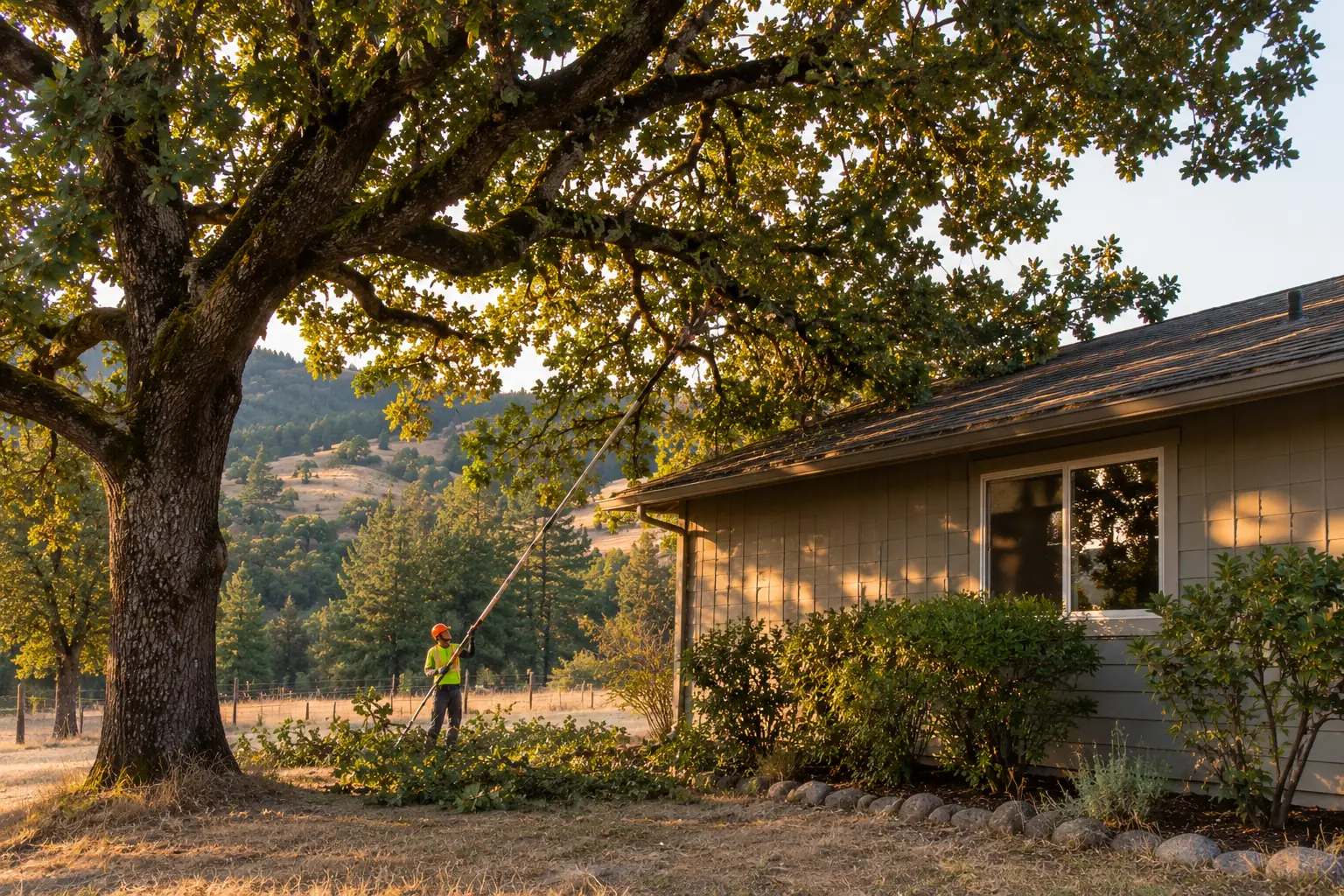
Tree trimming in Rogue River means cutting out dead wood, lifting low limbs off a roof or driveway, and thinning or shortening a crown without harming the tree. One free call to (541) 855-3193 puts you through to one independent tree service, licensed with the Oregon CCB. Ask it to look at the tree and write its price down. Whether that look is free is the company's to say, and for an ordinary trim it usually is.
What a trim job can include
A trim is a set of specific cuts, each with a reason, and a good estimate names which ones the company plans to make. The International Society of Arboriculture's homeowner sheet, Pruning Mature Trees, describes the common types this way:
- Cleaning takes out dead, dying, diseased and weakly attached branches.
- Raising removes lower branches to give clearance for a building, vehicles, people walking under the tree or a view.
- Reduction shrinks the height or spread of a tree, often to keep it clear of a utility wire.
- Structural pruning on a young tree sets up a strong trunk and branch layout for the decades ahead.
The same ISA sheet says that, as a general rule, no more than 25% of the crown should come out at once, and less on a mature tree. It also says a correct cut sits just outside the branch collar, the slightly raised ring of bark at the base of each branch. Flush cuts against the trunk tend to leave dead patches. If a quote talks about "cutting it way back" with no detail, ask what that means in percentages and which limbs.
Signs a tree on your lot needs trimming
Most homeowners call for trimming when a tree starts touching something. Around Rogue River that usually looks like one of these:
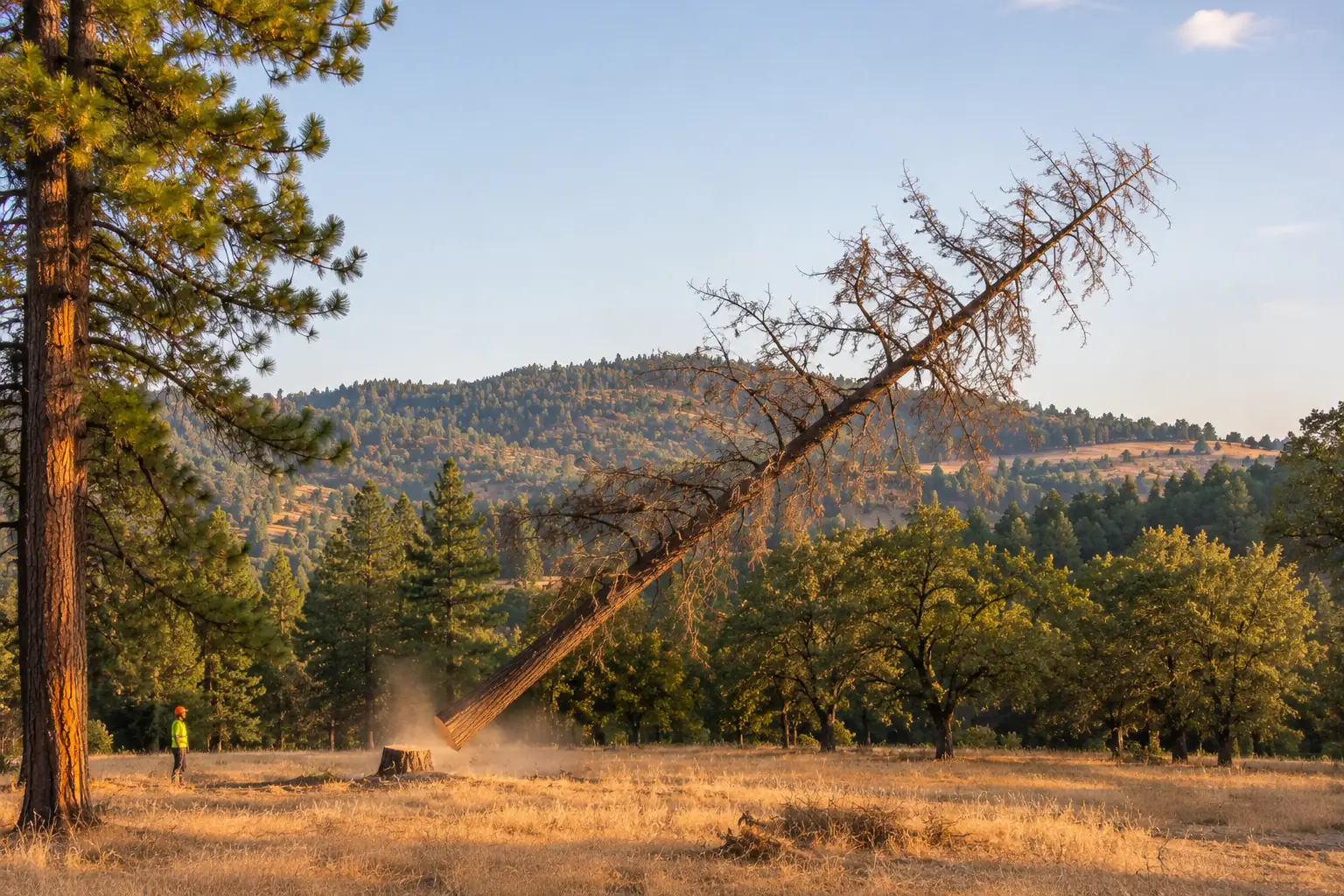
- Limbs rubbing the roof, gutters or a chimney, or dropping needles and leaves into the gutters every week.
- Branches hanging low over the driveway, so the truck or the RV scrapes on the way out.
- Dead branches in the crown, easy to spot in summer when the rest of the tree is green.
- A limb reaching toward the service wire that runs from the pole to your house.
- Lower limbs on pines and oaks sitting in dry grass or brush, which matters for fire.
- Two branches crossing and rubbing bark off each other.
A tree that has a cracked trunk, a fresh lean, or mushrooms and shelf fungus at the base needs more than a trim. The hazard and dead tree page covers what a tree service checks in that case.
How a crew usually trims a tree
A typical residential trim follows the same order whatever the species. Knowing the steps helps you compare two estimates fairly.
- Walk the tree. The crew lead looks at the crown, the trunk and what sits underneath: roof, fence, garden, septic lid, wires.
- Set up the drop zone. Cones or tape go around the area where branches will fall. Cars get moved.
- Choose the access. Low work is done from the ground with a pole saw. Higher work means a climber on ropes or a bucket truck, if the truck can reach the tree without crossing the drainfield or a soft lawn.
- Make the cuts. Larger limbs come down in pieces, sometimes lowered on a rope so they do not hit the roof.
- Clean up. Brush is chipped, logs are cut to length or hauled, and the yard is raked.
Ask how the company will reach the tree and what it will drive across. On a rural lot with a long gravel driveway, that answer often decides the price.
Rules on trimming inside Rogue River city limits
Inside the city, the Rogue River street tree ordinance, Chapter 12.20 of the municipal code, sets a few rules that affect trimming.
- Clearance over sidewalks and streets. Section 12.20.140 says the owner of a tree hanging over a street or right of way must keep the branches clear of streetlights and intersection sight lines, and must keep a clear space of eight feet above the sidewalk.
- No topping of public trees. Section 12.20.130 makes topping a street tree, park tree or other public tree unlawful as a normal practice. The code describes topping as cutting limbs back to stubs larger than three inches across, removing the normal canopy.
- Work on street and park trees. Section 12.20.020 says trees may not be planted in or removed from a public parking strip without the street tree committee's permission, and section 12.20.200 requires anyone in the business of pruning or removing street or park trees to hold a city license and carry at least $2,000,000 in liability insurance.
If a tree stands between the sidewalk and the street, ask City Hall at (541) 582-4401, the number on the city website, whose tree it is before anyone cuts. Outside city limits, in Wimer, Sams Valley or along the Evans Creek valley, the street tree chapter does not apply, but the riparian and fire rules below can.
Trimming trees beside Evans Creek, Wards Creek or the Rogue
Trimming near the water is allowed, but the city limits how hard it can be done. The riparian chapter, Chapter 17.135, sets protected corridors 75 feet back from the top of the bank on the Rogue River and 50 feet back on Evans Creek, Wards Creek and other fish-bearing streams. Section 17.135.080 says maintenance pruning inside those corridors should be kept to a minimum, should follow the ANSI A300 tree care standards, and must never be so severe that it hurts the tree's health or its job along the bank.
Outside the city, the Jackson Soil and Water Conservation District's Jackson County guide uses the same 75 and 50 foot distances and says clearing or thinning there is not allowed by default. If your trees lean over a creek, tell the company before it bids, and check with the city or Jackson County Development Services at (541) 774-6900 before heavy cuts.
Saw hours during fire season
Fire season changes when a crew can run a chainsaw. In 2026, the Oregon Department of Forestry's Southwest Oregon District started fire season on May 15. Its regulated closure proclamation for the district ties power saw use to the daily fire danger level:
| Fire danger level | When power saws may run |
|---|---|
| Low (green) | All day |
| Moderate (blue) | Before 1:00 p.m. and after 8:00 p.m. |
| High (yellow) | Before 10:00 a.m. and after 8:00 p.m. |
| Extreme (red) | Not allowed |
The same proclamation requires a shovel and a fire extinguisher of at least eight ounces with each saw, and a fire watch of at least one hour after the saw stops. Battery and electric chainsaws are covered too. A summer trim can therefore mean an early start and a short day. Many owners book trimming for late fall or winter, when most trees are dormant and the rules are off. The pruning calendar for the Rogue Valley goes species by species.
Branches near power lines
Leave any branch near a power line to the utility or a crew that is trained and cleared for that work. Pacific Power's tree page tells customers never to prune limbs or remove trees near power lines, says its crews prune for safe clearance at no cost, and offers a free temporary disconnect of the service to your house so tree work can be done safely. Call Pacific Power at 1-888-221-7070 for tree questions, and book the disconnect before the trimming date. That number is for requests that can wait. If a limb is already resting on a wire, stay 35 feet back, call 911 and then the downed-wire line at 1-877-508-5088.
What trimming costs
National cost guides give a starting point, and the price for your tree comes from the written estimate. LawnStarter's tree trimming cost guide, updated September 24, 2026, puts typical professional trimming at $430 to $640 per tree, with these ranges by height:
| Tree height | Typical price per tree |
|---|---|
| Under 30 feet | $85 to $415 |
| 30 to 60 feet | $215 to $790 |
| Over 60 feet | $475 to $1,835 |
The same guide lists pine trimming at $210 to $1,630 and oak at $230 to $1,480, and says trees near power lines or buildings, hard-to-reach trees and damaged trees cost more. Rural access, steep ground and hauling the brush away all move the number. Ways to keep the cost down include grouping several trees into one visit, keeping the chips on site as mulch and trimming before a small problem becomes a big limb. The tree service cost guide compares trimming with removal and stump work.
Questions to ask before you say yes
A few direct questions sort out most trimming quotes:
- What is your Oregon CCB number? You can look it up on the CCB license search or call the CCB at 503-378-4621.
- Will an ISA Certified Arborist be on the job or look at the tree? ISA's sheet says certified arborists pass an exam and keep up continuing education, and you can check a name with ISA's credential lookup.
- Which limbs come off, and about what share of the crown?
- How will the climber get into the tree, and will anything be done that marks or wounds the trunk?
- Is cleanup, chipping and hauling in the price?
- How will you handle fire season hours if the job lands in summer?
When you call (541) 855-3193, the tree service you reach sets its own prices and schedule. Read how this referral service works for the details, or go back to the home page for every service and town covered.
Frequently asked questions
When is the best time to trim trees in Rogue River?
Late fall through winter suits most shade trees here, since they are dormant and ODF fire season rules are not in force. The ISA pruning sheet says light removal of dead or weak limbs can be done any time of year with little effect on the tree.
Can I have my tree topped to make it shorter?
Topping is poor practice and, for street, park and other public trees in Rogue River, unlawful as a normal practice under section 12.20.130 of the city code. A crown reduction, cutting back to side branches, is the usual way to shorten a tree.
Who trims the tree touching my power line?
Pacific Power does, and never you or a tree service acting alone. If a limb is on the wire right now, stay 35 feet or more back, call 911 and then Pacific Power's downed-wire line at 1-877-508-5088. For branches that are only growing close, the utility prunes around its lines for safe clearance at no cost, and customer service takes those requests at 1-888-221-7070. For the wire running to your house, ask Pacific Power about a free temporary disconnect before a tree service works nearby.
How much of a tree can be cut in one trim?
ISA guidance says no more than 25% of the crown at once as a general rule, and less on mature trees. Ask the company to tell you the planned share in the estimate.
Do I need a permit to trim a tree on my own lot?
The city's street tree chapter covers trees in parking strips and public places. Trees inside the creek and river corridors fall under the riparian chapter, which limits how hard they can be pruned. For anything else, confirm with City Hall or Jackson County before work starts.